
C3 glomerulopathy treatment
 Fact-checked by
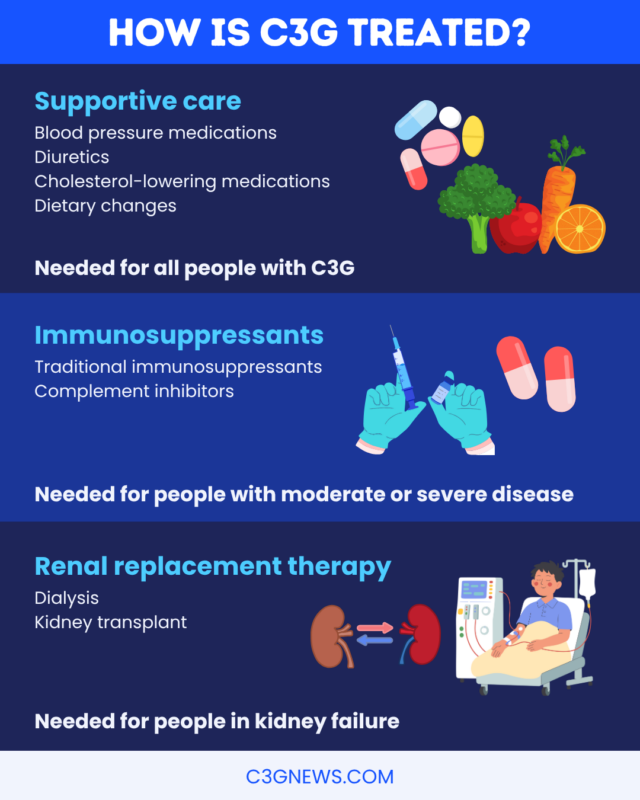
The treatment of C3 glomerulopathy (C3G) generally involves supportive care to protect the kidneys and medications to suppress the abnormal immune activity that drives the disease. In more advanced stages, dialysis or a kidney transplant may be needed.
C3G is an immune-mediated condition in which a part of the complement system, an immune system component, becomes overactive. Pieces of the C3 complement protein deposit in the kidneys, where ongoing complement overactivity causes progressive inflammation and damage.
There is no cure for the rare kidney condition, but available C3G treatment options help slow the progression of kidney damage and control symptoms. The two main types of C3G — dense deposit disease and C3 glomerulonephritis — are generally treated the same way.
First-line supportive care for kidney protection
All people with C3G, regardless of disease severity, should receive standard supportive care measures used for people with all types of chronic kidney disease. These may include the following:
- Blood pressure medications: Help reduce protein loss in the urine and control blood pressure; includes angiotensin-converting enzyme inhibitors and angiotensin II receptor blockers.
- Diuretics: Medications that help remove excess fluid from the body and reduce swelling.
- Cholesterol-lowering medications: Help lower the levels of fats in the blood and protect the heart.
- Lifestyle changes: A dietitian may recommend adjusting eating habits to help protect the kidneys, including lowering the intake of salt, saturated fat, and cholesterol. Maintaining a healthy weight and avoiding smoking can also help.
Some people with mild and stable disease may only need supportive kidney care with careful monitoring, without requiring other medications unless the disease shows signs of clinically significant progression.
Immunosuppressants and targeted complement inhibitors
Many people with C3G also require medications to help calm the immune system and stop it from damaging the kidneys. Immunosuppressants have typically been used for people with moderate or severe disease, but with the emergence of more targeted options, scientists are investigating whether there is a benefit to starting these treatments earlier.
Historically, the most widely used approach has been a combination of traditional immunosuppressants, which broadly suppress immune activity. The most commonly used for C3G is a combination of oral corticosteroids and mycophenolate mofetil.
Where available, complement inhibitor therapy may now be favored over these other immunosuppressants. This newer class of targeted immunosuppressants specifically addresses the underlying cause of the disease — complement system dysfunction. Complement inhibitors approved in the U.S. for CG3 include the following:
- Empaveli (pegcetacoplan): An under-the-skin (subcutaneous) injection therapy approved in the U.S. to treat C3G patients, ages 12 and older. It works by directly inhibiting C3 breakdown.
- Fabhalta (iptacopan): An oral therapy approved in the U.S. to treat adults with C3G. It works by inhibiting complement factor B, a protein that regulates C3 breakdown.
An older complement inhibitor, Soliris (eculizumab) is not approved for C3G, but it is approved for other complement-mediated diseases. It may sometimes be used off-label to manage C3G.
For children younger than 12, traditional immunosuppressants remain the standard of care, although complement inhibitors may be used off-label in some situations.
Data suggest that approved C3G complement inhibitors are more effective than traditional immunosuppressants for controlling kidney function decline. However, these medications carry warnings for potentially life-threatening bacterial infections, which can happen when the complement system — the body’s main line of defense against certain bacteria — is suppressed.
Plasma exchange therapy
While C3G usually progresses over several years, some people experience rapidly progressing disease in which kidney damage accumulates very quickly. In those cases, the following therapies may be used to help quickly get the disease flare under control:
- a short course of into-the-vein corticosteroids
- plasma exchange therapy
Plasma exchange therapy involves slowly filtering out the liquid component of blood (plasma) — which may contain harmful self-reactive antibodies and other disease-driving proteins — and replacing it with a substitute fluid or donor plasma before returning the blood to the body.
For people with C3G who have a deficiency in regulatory proteins that control C3 activation, using donor plasma that contains these proteins can also help put the brakes on the complement system and control disease activity. In some cases, donor plasma may be infused into the bloodstream without the blood filtering procedure.
Plasma exchange therapy only works temporarily, so it is often used to quickly manage a disease flare while other medications are still kicking in. However, concrete evidence of its efficacy in C3G is lacking, and this approach may not work for everyone.
Managing advanced kidney disease and transplant
About half of people with C3G will develop kidney failure in the 10 years after their diagnosis. At that point, medical interventions to replace the function of the failing kidneys are needed. Collectively known as renal replacement therapy, they include the following approaches:
- Dialysis: A procedure that regularly filters waste and excess fluids from the blood when the kidneys can no longer do so.
- Kidney transplant: The failing kidney is removed and replaced with a healthy kidney from a donor.
Importantly, a kidney transplant is not a cure for C3G, and the immune system may still attack the new kidney. As such, C3G commonly recurs after a kidney transplant and requires additional treatment with immunosuppressants or complement inhibitors.
C3G News is strictly a news and information website about the disease. It does not provide medical advice, diagnosis, or treatment. This content is not intended to be a substitute for professional medical advice, diagnosis, or treatment. Always seek the advice of your physician or other qualified health provider with any questions you may have regarding a medical condition. Never disregard professional medical advice or delay in seeking it because of something you have read on this website.